Showing posts with label Books. Show all posts

Wednesday, July 8, 2015

The Noah Plan®- Third Grade Essentials

Have you a third grade student this coming school year? What about using The Noah Plan® Curriculum for third grade as a spine for your mixed ages/grades? In any case, you may find this list of The Noah Plan® Curriculum's third grade Essentials list helpful as you get your curriculum ordered in time for the school year. :-)


The Noah Plan®- Third Grade Essentials List per FACE (The Foundation for American Christian Education):

This is the Essentials list by F.A.C.E. and the purpose of sharing this is to help you prepare and budget as you need to before your school year gets started (page 427 from The Noah Plan®
Curriculum for Third Grade). The books in bold lettering are the ones that we own:

  • Webster's 1828 American Dictionary of the English Language (You can get by without this and use the free on-line version of Webster's 1828 Dictionary. However, the on-line version does not have all of Webster's entries. For instance, you will not find the entry for fulfill.).

  • Benjamin Franklin, Ingri and Edgar Parin d'Aulaire

  • Christian History of the American Revolution: Consider and Ponder, Verna M. Hall
    (You can get by without this... eventually I recommend them to read a bit at a time to educate yourself and decided what and how much to share with your children).

  • Christian History of the Constitution of the United States of America, Vol. 1: Christian Self-Government, Verna M. Hall (You can get by without this... eventually I recommend them to read a bit at a time to educate yourself and decided what and how much to share with your children).

  • The Family and the Nation: Biblical Childhood, Rosalie June Slater

  • Hans Brinker or the Silver Skates, Mary Mapes Dodge

  • How to Teach Spelling (we use Spell to Write and Read instead...)

  • The Lion, the Witch and the Wardrobe, C.S. Lewis

  • NIrV Kids' Study Bible, Zondervan

  • The Noah Plan Curriculum Guides for:
    English, History and Geography, Literature, and Reading
    (You can get by without these... eventually I recommend them to read a bit at a time to educate yourself and decided what and how much to share with your children).


  • The Noah Plan®: A Complete Educational Program in the Principle Approach for grades K-8 or 9-12, FACE (I don't own these...)


  • The Noah Plan® Self-Directed Study in the Principle Approach, FACE


  • RightStart Mathematics (while I love this curriculum, we now use CTC Math and love it!)


  • Spalding Education International-
    Writing Road to Reading (we use Spell to Write and Read instead as it's simplified!)

     
  • The Comprehension Connection User's Gudie for McCall-Crabbs, for Book B-E
  • McCall-Crabbs, Standard Test Lessons in Reading (Book B- 3rd Grade)
    We do own the McCall-Crabbs books for reading comprehension and I do like to use them. The kids and I appreciate knowing what reading level they are at.
  • StoneBridge Art Guide, Wendy Giancoli, FACE

  • Tales from Shakespeare, Charles and Mary Lamb

  • Teacher Guide: Christopher Columbus: Christbearer to the New World, FACE

  • Teacher Guide: Holland or the Netherlands and the History of Liberty, for Hans Brinker or the Silver Skates, Rosalie June Slater

  • Teaching and Learning America's Christian History: The Principle Approach®, Rosalie June Slater (You can get by without this... eventually I recommend them to read a bit at a time to educate yourself and decided what and how much to share with your children).

Other books on their list that we own and have blessed our homeschool experience:


  • Children's Illustrated Bible, Selina Hastings, Dorling Kindersley
  •  Leif the Lucky, Ingri and Edgar Parin d'Aulaire 


  • The Light and the Glory for Children, Peter Marshall and David Manuel


  • The Magna Charta, James Dougherty


  • Physical Geography, Arnold Guyot (Heads up, there are some ideas in his book that I don't subscribe to. I don't teach some things he believed because I disagree with them.)
  • Poetry of Emily Dickinson, Robert Louis Stevenson, and Henry Wadsworht Longfellow


  • Sebastian Bach: The Boy from Thurngia, Opal Wheeler and Sybil Deucher


  • Squanto: A Friend of the Pilgrims, Clyde Robert Bulla


Other Resources We Have Added and Enjoyed:


  • The Lion, the Witch and the Wardrobe audio drama series by Focus on the Family


  • Squanto audio drama by Focus on the Family


I'm excited for you! The Noah Plan® curriculum is such a blessing to our family and I can't imagine it any different for your family. I pray you enjoy your journey of growing closer to our Heavenly Father as you learn Bible Principles in every subject.


Blessings!

Friday, June 19, 2015

The Noah Plan®- Second Grade Essentials

For this next post in my series of The Noah Plan® Essentials, I'm skipping First Grade and jumping into the Second Grade. Why? In my opinion, the Kindergarten and Second Grade curricula are more in depth than the First Grade curriculum (though I will get to the First Grade Essentials list before too long). You can read The Noah Plan® Kindergarten Essentials List by F.A.C.E. here.


**This post does contain an affiliate link.***  


If you own some of the Essentials that F.A.C.E. recommends from previous grades, you'll happily spend less money on this school year or you'll have more money to apply toward other books. :-)

This is the Essentials list by F.A.C.E. and the purpose of sharing this is to help you prepare and budget as you need to before your school year gets started (page 382 from The Noah Plan® Curriculum for Second Grade). The books in bold lettering are the ones that we own:

  • Webster's 1828 Dictionary. (While you may use an on-line copy, I have found that not all words are in the on-line version. An example word would be "fulfill". So, a hard copy is best if you can swing it).

  • Benjamin Franklin, Beautiful Feet Books.

  • Benjamin West, Bradford Press.

  • Christian History of the American Revolution: Consider and Ponder, F.A.C.E.
    (You can get by without this. It's a wonderful book to have, but if it overwhelms you in the beginning, wait until you practice the Principle Approach method using the curriculum.)

  • Christian History of the Constitution of the United States of America, Vol. 1: Christian Self-Government, F.A.C.E.(You can get by without this. It's a wonderful book to have, but if it overwhelms you in the beginning, wait until you practice the Principle Approach method using the curriculum.)

  • Mes Premiers Pas de Francais, F.A.C.E.
  • NIrV Kids' Study Bible
    We have it but rarely use it because I just am not a big fan of NIV...
The Curriculum Guides:
  • Noah  Plan® English Guide
  • Noah Plan® History and Geography Guide
  • Noah Plan® Literature Guide
  • Noah Plan® Mathematics Guide
  • Noah Plan® Reading Guide
  • Noah Plan® Self-Directed Study Seminar and Principle Approach Methodology
    (You can get by without these, but as you grow in your understanding and ability of applying the
    Principle Approach® method, you'll find them a huge blessing.)

  • Pocahontas (d'Aulaire), Doubleday

  • Right Start Mathematics, Grade 2 Lessons, Activities for Learning
    I LOVE Right Start, however, I needed to "farm out" lessons and we are now using CTC Math (affiliate link) and we absolutely love it!
    The lessons are short and concise, the kids can re-take lessons and tests as needed individually, it is not in line with common core, it keeps track of individual student's records which are printable, and it grades lessons and tests automatically. This has been a huge blessing for me and our kids!


  • Starter Kit, Spalding Education International:
    I have it and struggled so much with the way it is formatted!!! Thankfully someone introduced me to Spell to Write and Read by Wanda Sanseri! It's based off of Spalding's book but so simplified. I absolutely love it.

  • Tales From Shakespeare, (Lamb's)

  • Teacher Guide: "Switzerland and Liberty," F.A.C.E.
    I don't own this...

  • Teacher Guide: "William Penn and the History of Religious Toleration," F.A.C.E.
    I don't own this but I'm thinking that I should.


  • Teaching and Learning America's Christian History, F.A.C.E.

Heather's List of Essentials


In addition to what F.A.C.E. recommends, the following blessed our experience with the second grade curriculum (you may be able to find several of them at your local public library or at used book stores):

  • Children's Illustrated Bible, Penguin Group

  • Heidi, Random House Value Publishing
    (I had never read the book before and I LOVE it!)

  • Historic Sailing Ships Coloring Book, Dover Publications, Inc.
    (You might be able to find free coloring pages on-line though.)

  • John Cabot & Son, Goodnough, Troll Association, 1979

  • John Smith, Man of Adventure, Bostong: Houghton Mifflin

  • McGuffey's Second Eclectic Reader, Christian School Edition
    (We found the collection inexpensively at a used book store.)

  • Men of Science, Men of God: Great Scientists of the Past Who Believed the Bible, Henry Morris.

  • Physical Geography, Arnold Guyot, American Christian History Institute

  • Planets, Evan-Moor Corp.

  • Pocketful of Goobers: A Story of George Washington Carver, Lerner Publishing Group

  • Strong's New Exhaustive Concordance of the Bible (but usually I use Blue Letter Bible)

  • Sun, Moon, Stars, Evan-Moor Corp.

Would I like to add more to our personal collection for second grade? Yes! However, I'll likely continue to teach with what we have considering that we have a budget for purchasing items for our High School kids. :-)

I sure hope this post gives you the ability to plan ahead and get you ready for the upcoming school year.


Blessings!


Wednesday, June 17, 2015

The Noah Plan- Kindergarten Essentials: Heather's List

Welcome back to my series of The Noah Plan Essentials. You may read my first post for The Noah Plan Kindergarten curriculum here.


In addition to the essentials for Kindergarten found at my previous post, here is a list of other items which I found benefited our family in our first year using the Kindergarten curriculum:

  • Free printable coloring pages for the period of history or maps that we were studying. A quick on-line search helped me do this and was more affordable at the time than buying coloring books.

  • Beginning Geography, K-2, The Evan-Moor Corp.: Vol. 1,Continents and Oceans; Vol. 2,  How to Use a Map; Vol. 3. (While I started out looking for free graphics on-line to make my own, I found having the books a time saver.)


These books have sheets that work with the K Geography lesson plans. They have proven to be a time saver for me (one less thing to prep). 


The double-sided poster is helpful. It's large for little people to see well and it also folds up and can sit loose-leaf in the Evan-Moor book.


The world map from the Evan-Moor Beginning Geography book is a duplicate of the one from their Land Form and Bodies of Water map on one side. The other side is a little Fairy Tale Land map. This also is large and fold-able which allows for sitting in the book loose-leaf.

  • The Children's Illustrated Bible. Why? Because unlike the "beginner Bibles", the illustrations are more realistic. I believe the benefit of this is that it doesn't place doubt in our children's minds. 

  • Learning About My Body by Evan-Moor Corp. The Noah Plan curriculum calls for, Me and My Body, Penguin Group, USA although we were unable to find a copy of it when we were initially ordering our books. It also calls for, Skeleton Inside You. I don't know what that book is like, however, there are coloring pages in the Learning About My Body book and that was satisfactory for me. In any case, it's helpful timewise to have these pages available.

  • A Child's Garden of Songs: The Poetry of Robert Louis Stevenson in Song by Ted Jacobs. We enjoy poetry and music. So, to help instill a love for both, it's especially nice to have some of Robert Lewis Stevenson's poetry put to music.This helped with our lessons about Robert Louis Stevenson when we had to be on the road.


Other than that, the usual supply of paper, paper reinforcement labels, pencils,crayons, or any other art supplies and creativity are needed.


Please feel free to ask ideas for substitutions if you find you need help with ideas for any specific lessons. I'll do my best to respond in a timely fashion.


Blessings!


Monday, February 3, 2014

On Western Thinking...


What does this have anything to do with the life of a Christian and education? What is western thinking any way? *West* indicates direction. West of where?...


Asia! 


Principle Approach, Asia Continent of Origins, Hebrew Mind-Set, Greek Mind-Set


To me, this is fascinating stuff! It helps explain ancient history and also many things about the Christian faith today (i.e. church history).

Asia is the Continent of Origins...


Have you considered that Asia is the Continent of Origins? I'm not in on the secret original location of the Garden of Eden, but I do know that Israel is the center of stage. I know that Hebrews were chosen to write Yahweh's inspired written Word. Therefor, Scripture was written with a Hebrew mindset. It's logical that Asia would be created with the distinct purpose of being the Continent of Origins.

Hebrew Education vs. Greek Education...


Have you considered that there is a stark contrast between the Hebrew mindset and the Greek mindset? This Greek mindset affects us as Christians because our culture (and many, many other cultures) have been so heavily influenced by Greek thinking. It only makes sense that these views would be opposites and that the world would embrace the Greek mindset. So, as Christians, we need to re-educate ourselves to think and reason Biblically. That means that there is a lot which the world holds onto and that we have gone along with because it's what we have grown up with. These are common things which we are to turn away from. So, by testing ideas, philosophies, actions, traditions, etc. against Scripture, we then learn a Biblical world-view.


Hebrew Education,  Hebrew Mind-set, Greek Mind-Set


As we study the Providential History of America (affiliate link, thank you), we see how the Gospel message has moved westward. *Something our family has come to realize from various studies is that western thinking hitchhiked with the western spread of the Gospel.

Often times people interject, "American thinking" into a conversation about western thinking as though America in and of itself is bad and at fault for the ailments of the world. Um, we live in a fallen and broken world and no place is a utopia. So, I want to clarify that many cultures have been impacted by Greek thinking- not just America. Individual cultures are far removed from the Hebraic culture. Why does this matter? Because people in general, regardless of where they live on this planet, are a part of the sin problem. And... because since the historical context and setting of the Bible is from a Hebrew mindset, we need to learn to think in this way.


Considering the End Goals of Christian Education...


Is one of the end goals of education within your family a Classical Hebraic Education? Is it to endeavor to learn and practice for yourself to be self-governed under Yeshua the Messiah- and to teach, encourage and motivate your children how to be? It's something to consider.


Thank you for reading this post today. I hope it challenges and encourages you to look more into applying the Hebrew mindset to learning in all areas of life. It's a journey we love!


Blessings!

Thursday, January 16, 2014

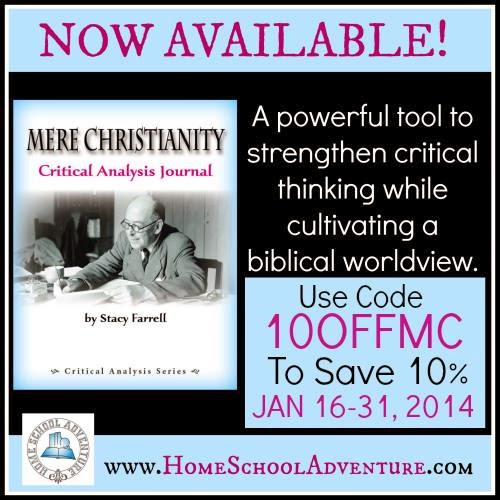
Review: Mere Christianity Analysis Journal


The Homeschool Adventure Co. has taken us on an adventure with the Mere Christianity Critical Analysis Journal. I feel very blessed to be a part of this book launch team. I have loved getting to know Stacy and I appreciate all of the time and work she has invested in creating a quality product for us to use in our homeschool. Today I am excited to share with you about our journey in this review!


How this looks in our homeschool...


Since we incorporate Bible Principles in our studies, we decided to begin with a word study just to make sure we correctly understood what the word *mere* means (and you all know how I love word studies!). :-) 

Webster's 1828 Dictionary 

MERE, adjective [Latin merus.] This or that only; distinct from any thing else. 1. Absolute; entire. MERE, noun [Gr. to divide.] A boundary; used chiefly in the compound, mere-stone. MERE, verb transitive To divide, limit or bound.

What the Bible says about divide?

"
Jesus knew their thoughts and said to them: “Any kingdom divided against itself will be ruined, and a house divided against itself will fall.." Luke 11:17


"Study to shew thyself approved unto God, a workman that needeth not to be ashamed, rightly dividing the word of truth." 2 Timothy 2:15

Leading Idea: There are distinct, absolutes that unite Christians as believers in Jesus Christ the Messiah.

Bible Principle: Focus on unity.Luke 11:17  {We are learning as we study the Word of God and are in different places in our faith journey.} 

As we read through Mere Christianity and as we walk through the questions in the Mere Christianity Critical Analysis Journal, we learn that C.S. Lewis was trying to get down to the core of what the Christian Faith is about. Any kingdom divided against itself will be ruined. We can't let that happen amongst ourselves! If we understand what the core of the Christian Faith is, the hope is that Christians will not be divided against each other over their different areas of personal growth and Biblical scholarship.


I did receive a copy of Mere Christianity Critical Analysis Journal in an ebook format in exchange for my honest review. I keep my printable sheets from the ebook in this nice binder. I love having an answer key available; it helps me to keep focus (as you know, I have several little ones yet and you can imagine they need me frequently during studies). As a part of Stacy Farrell's journal design, the teacher's journal has space available to jot down notes and references as one chooses.

In order to go through the Mere Christianity Critical Analysis Journal, I needed a copy of Mere Christianity. My book budget is sadly depleted for a time and while the library had a copy, I couldn't make it down there. Thankfully there is this fabulous thing called the Public Domain and I printed out a copy from there. This worked out better for me in the long run because I could make little notes in the margins and highlight like a mad artist. 


I had never read Mere Christianity {though I had heard of it}. I now know that Lewis was writing about "Absolute or Entire Christianity." And the Mere Christianity Analysis Journal helps us to discover what C.S. Lewis meant (with this journal, I didn't feel that I needed a background with this book by C.S. Lewis). So, I took Scientist and Artsy girl on this Homeschool Adventure Co. expedition and we explored Lewis' thoughts together.  


Scientist and Artsy Girl are in Junior High and the Mere Christianity Critical Analysis Journal is a good fit for where they are at educationally. It goes right along with the heart of our homeschool. We want our children to learn to think and to challenge ideas. We want them to hold ideas up in light of Scripture and to learn from great thinkers... to learn a Biblical Worldview.

Our children are very familiar with C.S. Lewis' writing style (I have lost count how many times they have read the Narnia series!). Just the same, some of his wording is complex as he presents complex matters about the Christian Faith. Therefor, we have hit some spots where they weren't comprehending a point C.S. Lewis' made, so we pulled out Webster's 1828 Dictionary and got creative with analogies.


I'm thankful to have this excellent resource in our homeschool. With a houseful of imperfect people (raising hand), we have a lot of discussion about thoughts that Lewis' expressed. Many of his ideas highlighted within the Mere Christianity Critical Analysis Journal can easily be key topics for family life... after all, the body of Christ outside of home is a larger extension of the home.


We are still making our way through the journal. I want to be sure to linger a while in each chapter and each point so that we are sure to consider Lewis' thoughts and apply the 4R Method (Research, Reason, Relate and Record). It's important for us to make sure that what Lewis' says agrees with Scripture... to know it for ourselves. 


Here is what you can find in the journal...


Book One – Right and Wrong as a Clue to the Meaning of the Universe
Book Two – What Christians Believe
Book Three – Christian Behavior
Book Four – Beyond Personality (or First Steps in the Doctrine of the Trinity)


Each chapter contains...


There are 10-16 questions in each chapter. Each one causes us to reflect on a point which C.S. Lewis made, to discuss it, and in our family we felt driven to research the Bible to see if indeed it holds up to Biblical truth (it's good practice!). Responses in our journals vary in length, depending on each individual. (While the teacher guide does include answers found within Mere Christianity, I like to have our children narrate and relate in their own words.)

How much does the Mere Christianity Analysis Journal Cost?...


The Mere Christianity Critical Analysis Journal is available from the Home School Adventure Co. for $28.95. The cost of the book Mere Christianity is separate (or you can download it from the Public Domain for free). If you'd like to purchase the book for $9.96 via my Amazon.com link to help support Principled Academy, it would be appreciated! :-)


I recommend the Mere Christianity Critical Analysis Journal for... 


Since the Mere Christianity Critical Analysis Journal teaches from a Biblical Worldview, this would be an excellent resource for:

Homeschools
Homeschool Co-ops
Study Groups
Churches
Families
Private Christian Schools
*All Christians regardless of how long they have been a Christian


*This would help Christians from Jr. High to adults to reason from Scripture what it is that unites us and defines us as Christians. All too often division is caused over things that do not meet the definition. Going through the Mere Christianity Analysis Journal will help believers to have a mature, Biblical framework to go by.  Mere Christianity is used in many seminaries but it does not need to be limited to those scholars!

You can also find The Home School Adventure Co. on facebook by clicking on this link here.

Author Bio


Stacy Farrell’s worldview changed when she embarked on her homeschooling adventure in 2002.
Her background as a consultant and writer well-prepared her to teach communication skills; however, only hands-on experience (and much time spent on her knees) equipped her to mentor her sons through the character-transformation required to help them work toward their full potential.


Stacy has spoken at a variety of homeschool conferences and has published articles in leading Christian magazines. She wrote scripts for Willow Creek’s youth ministry, copy for Pastor Bill Hybel’s “Defining Moments” Audio Newsletter, and a broad range of material for corporate and non-profit clients. She also managed a law firm that specialized in civil rights litigation and constitutional law. Today, she loves to help empower students to recover territory lost by “fuzzy thinking” and low expectations. To that end, she created:

 
Philosophy Adventure™—Pre-Socratics – designed to help students 6th-12th grade cultivate and defend a biblical worldview by teaching them how to write skillfully, think critically, and speak articulately as they explore the history of ideas.


Philippians in 28 Weeks™ — a simple and painless way to memorize an entire book of Scripture.


The Wise Woman with Literary Analysis Journal Questions – an enchanting fable that unmasks the ugliness of pride and selfishness.


Mere Christianity Critical Analysis Journal -- a powerful tool to strengthen critical thinking while cultivating a biblical worldview.


Although Stacy loves to write, speak, and teach, she considers her role as wife to Roger and mother to two precious sons to be her greatest work and privilege. You can learn more about her resources at Homeschool Adventure.


Blessings!


Tuesday, January 7, 2014

An Author Interview: Mere Christianity Critical Analysis Journal

I love meeting people! Today, I'd like to introduce to you the lovely Stacy Farrell; she is the owner of Home School Adventure Co., authoress of the Mere Christianity Critical Analysis Journal, and blogger at On Loving Jesus. Won't you grab your favorite warm beverage, get cozy and enjoy getting to know Stacy Farrell? I think you'll see and appreciate her dedication and heart behind what she produces for the homeschool community. 


Before too long, I'll share a review with you about her Mere Christianity Analysis Journal. But for now, here is an interview with her as a part of her book launch {psssst. Check out the special deal she has going for pre-orders!!}


The Interview with Stacy Farrell


Q: When planning a new book, how do you go about planning for it? Do you have a method you use, or is each one different? 

A: Proverbs 16:9 declares: “In his heart, a man makes his plans, but the Lord determines his steps.” If you had asked me this question 20 years ago, I would have told you how I outlined and scheduled and planned. I’m a planner by nature. However, I have learned the hard way that “unless the Lord builds the house, the workers labor in vain” (Psalm 127:1).

Each book I have written for Home School Adventure Co. has a unique story behind it—and not one would have been completed without the support of many faithful prayer warriors.


Q: Do you have a certain writing space, somewhere you go *just* to write your books? An office, a lake cabin, a hotel? What do you love about that space? How does it inspire you?


A: Writing resources for Home School Adventure Co. has pretty much demanded everything I can give to it (and more!). So, wherever I go, my writing goes with me.

I am especially grateful to my sons for helping me lug around the backpack and bags that contain my laptop and research materials.


Q: What would you say to a young person who aspires to be a writer? What advice would you give? Also, what would you tell his/her parents in order to help them be supportive in their child's efforts to pursue writing as a career?

A: Writing is hard work. Sometimes inspiration hits and the words simply flow. However, the writer who consistently writes can ultimately surpass a more talented writer who waits for the Muse before picking up his or her pen (or keyboard).

Think of eternity, always. Imagine that moment when you will stand before God and give an account for what you have done with the talents He entrusted to you. Let that guide all your decisions.

Parents, encourage your students to write every day. Then take the time to read and comment on what they write. Even if you do not consider yourself a writer, surely you consider yourself a reader. What is clear? What is confusing? Applaud their efforts and tell them the truth.


Q: Would your advice be any different (from question #3) for an adult who would like to break into the business? How?

A: Pray. Listen. Obey.

“Count the cost.”

Luke 14:28 tells us to consider the price we must pay before undertaking a work, but there is also a cost associated with not undertaking a work to which He calls us.

That said, as parents and family members, we would be wise to maintain a measure of balance. Remember Solomon’s words: “The writing of many books is endless” (Ecc. 12:12). Books will pass away; people are eternal.

Do not allow your writing to interfere with your loving.

Q: What is your goal with writing? Is it the same with every book?


A: My goal for every book is the same as my goal for life. I pray that all my efforts help people more fully know and love Jesus.

Q: What other projects will you be working on in the near future?

A: In 2014, we hope to release a print edition of Philippians in 28 Weeks – King James Version.

Q: What is one lesson you learned from writing this book?

A: Simple truth packs a punch.

In Mere Christianity, C. S. Lewis tackles some hefty questions. Yet, upon pondering his answers, I realized that much of what he says distills down to common sense.

(Voltaire would argue that “common sense is not so common.”)

Q: What books have most influenced you?

A: Different books have impacted me during different seasons of my life.

Q: With all of the duties that you juggle, when do you fit in the time to write?

A: This is a great question. There is no denying that writing requires many sacrifices. Truth be told, all too often my sons have heard me say, “I need to concentrate. Please don’t talk to me right now!” However, because my sons need and deserve my focused attention during our school days, much of my writing is done before dawn (while my household sleeps), or late at night.


Q: What is the Scripture verse that you would call your favorite?

A: At a writer’s conference some years ago, I came to believe that Philippians 2:14-16 might be my “life verse.”

I could not pick a favorite verse, but I can say that I feel particularly convicted to live out Philippians 2:14-16:

“Do everything without grumbling or arguing,
so that you may become
blameless and pure,
children of God without fault
in a warped and crooked generation.
Then you will shine like stars in the sky
as you hold out the word of life.”

Author Bio


Stacy Farrell’s worldview changed when she embarked on her homeschooling adventure in 2002.
Her background as a consultant and writer well-prepared her to teach communication skills; however, only hands-on experience (and much time spent on her knees) equipped her to mentor her sons through the character-transformation required to help them work toward their full potential.


Stacy has spoken at a variety of homeschool conferences and has published articles in leading Christian magazines. She wrote scripts for Willow Creek’s youth ministry, copy for Pastor Bill Hybel’s “Defining Moments” Audio Newsletter, and a broad range of material for corporate and non-profit clients. She also managed a law firm that specialized in civil rights litigation and constitutional law. Today, she loves to help empower students to recover territory lost by “fuzzy thinking” and low expectations. To that end, she created:

Philosophy Adventure™—Pre-Socratics – designed to help students 6th-12th grade cultivate and defend a biblical worldview by teaching them how to write skillfully, think critically, and speak articulately as they explore the history of ideas
Philippians in 28 Weeks™ — a simple and painless way to memorize an entire book of Scripture
The Wise Woman with Literary Analysis Journal Questions – an enchanting fable that unmasks the ugliness of pride and selfishness
Mere Christianity Critical Analysis Journal — a powerful tool to strengthen critical thinking while cultivating a biblical worldview.


Although Stacy loves to write, speak, and teach, she considers her role as wife to Roger and mother to two precious sons to be her greatest work and privilege. You can learn more about her resources at homeschooladventure.com.

More By Stacy...


Stacy has authored a few other biblical world view products, such as Philosophy Adventure, which may bless your high school home schooler as well. Won't you check them out? Just click on the image below and visit her website!

http://www.homeschooladventure.com/products/philosophy-adventure-pre-socratics/


So, have you used any homeschool products from the Home School Adventure Co.? What have you liked about them and which ones do you recommend? Leave a comment below!


Blessings!

Saturday, February 2, 2013

Treasures of the Snow - Literature Guide!

{Get your free literature guide at the end of this post!}

Have you read, Treasures of the Snow by Patricia St. John? We learned about it from the My Father's World: Creation to the Greeks curriculum we are using this year. This book is full of meaningful lessons and illustrates bearing the Fruits of the Spirit as the main characters choose to walk in Jesus' ways toward the end of the story.

Lately, I have been working on refining the literature guide format for our book club discussions. One goal was to streamline the material. Another goal was to have the kids put into practice applying the Principle Approach® method. This allows the kids to be more independently involved with the research, reason and relating aspects.


©Principled Academy 2013

We went through some of the guide in our group but we didn't make it through to the end of the book due to time constraints. However, the discussions we did have were rich. We mothers 

Wednesday, January 9, 2013

Mother Goose Mystery- Book Review


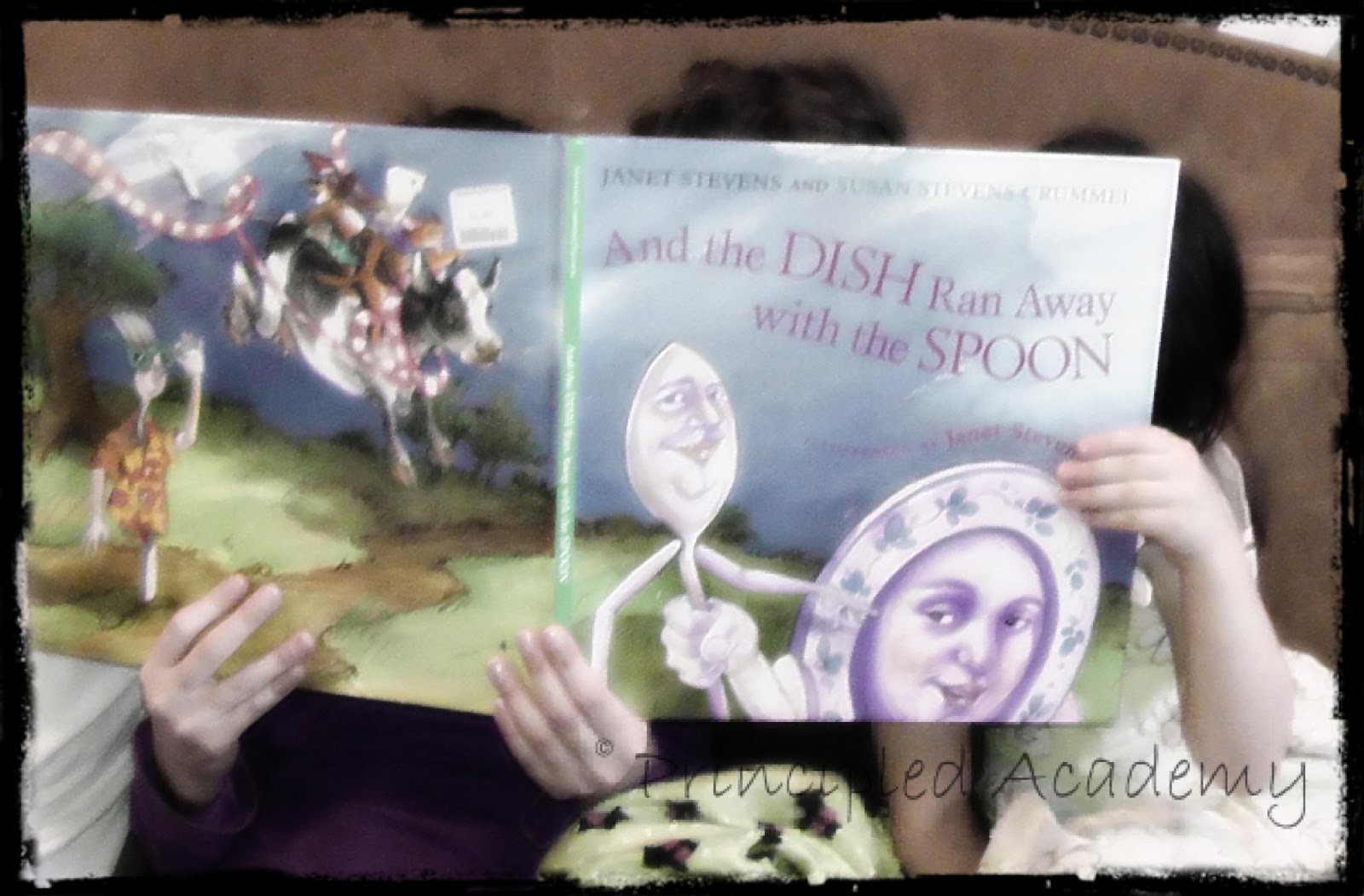
We have already studied about Mother Goose this school year in our lessons, however, I have to share about my recent find...

© Principled Academy

Do you know this book exists? I had not a clue until I came across it during my great book hunt for our family library.

First of all, I have to say that one tiny reason (outside of innumerable other tiny reasons) I am thankful to still have younger children in my life is because of the treasure trove of children's literature! I enjoy reading so many delightful, imaginative stories that I'd really miss out on if I didn't have littler ones to read to. Can you relate?

The illustrations are visually engaging and my kids enjoy the story line. It begins with the dish and spoon missing! They didn't come back after they ran away, like they usually do! Something had to have happened to them, but what? If the characters in the nursery rhyme don't find them before the next nightly reading, the rhyme is ruined! The dog and cow suggest they simply alter the rhyme so they don't have to go looking. However, it is finally decided that they go on an expedition all together to inquire of other nursery rhyme characters about their friends. Mystery, danger (hey, a wolf and a giant can make any story have danger), and suspense are all rolled up in this book. 

Second of all, this book illustrates Bible Principles wonderfully! It's the Bible Principles that popped out at me which I love best...

©Principled Academy

©Principled Academy

©Principled Academy


... and which are timeless for all ages as Bible Principles are for all people of all ages. So, even if nursery rhymes are beyond your kids' ages, they can read the book to their younger siblings or younger children you watch for a friend and sit in on the Bible Principles which you teach regarding the story. It helps the older kids practice reasoning from Scripture and how to see Bible Principles in even the "simplest" of stories (which in turn helps them to see Bible Principles in other ares of learning and life).

Don't have a copy of this story book? You can purchase it at my amazon affiliate link below:

You can download your Bible Principle Literature Guide for this storybook for just $5 here at my store.


 Blessings!


Copyright 2013 of Principled Academy
 The duplication of articles, photos, or blog entries without the express permission of the owner are strictly prohibited.