Showing posts with label Noah Plan. Show all posts

Sunday, May 22, 2016

Walking With Jesus Notebook Pages!

Look at what's now available! 

The complete set of notebook pages for Walking With Jesus is here! 


Walking With Jesus notebook pages are beneficial for those who:


  • Want to save time by not having to create notebook pages themselves,
  • Want to save time by not having their students attempt to create notebook pages by hand,
  • Want a cohesive look throughout the notebook. 

If you have visited my About page, you will already know about my passion to share Biblical truths! The Walking With Jesus notebook pages help your students to become more Biblically literate by learning:

  • The name of the One True God of Isaac, Jacob, and Abraham in Hebrew. His name is Yahweh (Isaiah 42:8 HCSB)

  • The name of Jesus in Hebrew. His name is Yeshua (which means salvation),

  • The word "church" is G1577 and more correctly rendered as "assembly" or "congregation".  

  • The Apostle Paul's name is Shaul in Hebrew.

These words are used interchangeably in the notebook pages to help your students build their Scriptural vocabulary. 

You can go to this link here and purchase it individually or as a set with the Walking With Jesus curriculum!

A big shout out to my family as they helped with scheduling so that I could accomplish this goal! 


Monday, October 26, 2015

Our Principle Approach®-based Homeschool Co-op

Well this school year is shaping up to be one of the most exciting ones for us yet. In previous years, I was able to share how to use the 4-R Method in Art when I wrote and taught Art lessons. This year, I find that I'm serving others in English, History, and Botany.

“Creative Commons Classroom” by William Creswell is Licensed under "Attribution 2.0 Generic."
Text and overlay are added by Principled Academy.


This is allowing me to put the curriculum I'm writing to the test with grades Kindergarten through 12th grade. We are, for the most part, in a one-room class. We meet with K-12th in one room for English, History, and Spanish. For Science we divide into two groups: Chemistry is taught by a very dear and sweet friend to grades K-7th and I'm teaching Botany to 8th-12th grades.

In English class, we're covering The Foundations of Language and spelling rules along with phonograms in support of the Spell to Write and Read program. We'll be using games for spelling and for English grammar to help reinforce what is being taught at home.

In History, we're covering some of Ancient History to the Protestant Reformation- as directed by The Noah Plan's sixth grade overviews. So far, it's working out well, I think, when teaching the Bible Principles and explaining things in a story-type manner. 


Then we take a 15 minute break-- stretch, get the wiggles out, go potty.


Once break is over, the kids divide into the two groups for Science. In Botany, we're studying the systems and functions of plants. Labs are included, 4-R Method studies are applied, and we are also learning about one of America's first botanists, William Bartram. The students will be writing a paper based on what they learn. In addition to High School credit for science, they are able to get High School credit for a literary study based on Bartram's writings.

Afterward, we all meet in a one-room class again for Beginning Spanish. Vocabulary is sent home so that we may practice conversations in class.

I'm sending the kids home with some notebook pages to do during the week (for subjects other than Spanish)... increasing the challenge of research, thought, and study as the grade levels increase.


It's so lovely how the Bible Principles of each subject are not "grade-based," allowing for children in all grades... all ages... all learning abilities to understand what Scripture teaches regarding the various subjects.

At this point, things are going really well. I'm very impressed with how self-governed and respectful all of the kids are. Teaching them is an honor and I feel very blessed to be able to share with them and their parents the richness of the 4-R Method. My prayer is that they will draw closer to our Lord and Savior as they dig into the Scriptures to learn truth.

So, there are two gifts coming up for you. Yes you! Please be sure to check back soon! :-)


Thursday, September 24, 2015

Planning My Principle Approach® School Year- Part 3

Not too long ago, the Foundation for American Christian Education held a "Renewing the Mind" summer training course. I'm so thankful for the opportunity to attend on-line. 


(Did you catch Part 1 and Part 2?)


How I'm Encouraged and Inspired:


A Few Things I Learned:

As you probably know, I have several children and several books from F.A.C.E. and not so much in the way of several hours to pour over every detail of each book. So, some areas of understanding have not been as strong for me as others.

  • I now have a better understanding about teaching reading and how to use different reading strategies.

  • I better understand how to apply the reading strategies with the Bible as a Reader. 

  • Why we use Word Study vs. RIGGS

Beneficial Tips for Me:

  • Use tabs on the Curriculum Guides for quick reference of where to find content.

  • How to better incorporate oral reading and inflection in our lessons.

  • How to effectively group kids together for reading (which helps with co-ops, maybe literature clubs, and I think for families with multiple kids). 

Midst daily life responsibilities, the joy of family and friends, and celebrating Yahweh's/God's Fall Feasts, I'm plugging away at the curriculum for this school year. I'm nearly ready to debut the first quartet lessons. I find that I can offer bits and pieces at a time vs. the whole curriculum at once as I was hoping. That's okay. I'm doing what I can as I'm able to. :-)

I do have an upcoming surprise for those who plan on using these lessons! I'm looking forward to introducing you to a special person and how he is sharing his gifts and talents to bless you!

Blessings upon you and yours as you pursue our Heavenly Father's will for your family and grow in Him and ever closer to our Messiah Yahshua.


Wednesday, July 8, 2015

The Noah Plan®- Third Grade Essentials

Have you a third grade student this coming school year? What about using The Noah Plan® Curriculum for third grade as a spine for your mixed ages/grades? In any case, you may find this list of The Noah Plan® Curriculum's third grade Essentials list helpful as you get your curriculum ordered in time for the school year. :-)


The Noah Plan®- Third Grade Essentials List per FACE (The Foundation for American Christian Education):

This is the Essentials list by F.A.C.E. and the purpose of sharing this is to help you prepare and budget as you need to before your school year gets started (page 427 from The Noah Plan®
Curriculum for Third Grade). The books in bold lettering are the ones that we own:

  • Webster's 1828 American Dictionary of the English Language (You can get by without this and use the free on-line version of Webster's 1828 Dictionary. However, the on-line version does not have all of Webster's entries. For instance, you will not find the entry for fulfill.).

  • Benjamin Franklin, Ingri and Edgar Parin d'Aulaire

  • Christian History of the American Revolution: Consider and Ponder, Verna M. Hall
    (You can get by without this... eventually I recommend them to read a bit at a time to educate yourself and decided what and how much to share with your children).

  • Christian History of the Constitution of the United States of America, Vol. 1: Christian Self-Government, Verna M. Hall (You can get by without this... eventually I recommend them to read a bit at a time to educate yourself and decided what and how much to share with your children).

  • The Family and the Nation: Biblical Childhood, Rosalie June Slater

  • Hans Brinker or the Silver Skates, Mary Mapes Dodge

  • How to Teach Spelling (we use Spell to Write and Read instead...)

  • The Lion, the Witch and the Wardrobe, C.S. Lewis

  • NIrV Kids' Study Bible, Zondervan

  • The Noah Plan Curriculum Guides for:
    English, History and Geography, Literature, and Reading
    (You can get by without these... eventually I recommend them to read a bit at a time to educate yourself and decided what and how much to share with your children).


  • The Noah Plan®: A Complete Educational Program in the Principle Approach for grades K-8 or 9-12, FACE (I don't own these...)


  • The Noah Plan® Self-Directed Study in the Principle Approach, FACE


  • RightStart Mathematics (while I love this curriculum, we now use CTC Math and love it!)


  • Spalding Education International-
    Writing Road to Reading (we use Spell to Write and Read instead as it's simplified!)

     
  • The Comprehension Connection User's Gudie for McCall-Crabbs, for Book B-E
  • McCall-Crabbs, Standard Test Lessons in Reading (Book B- 3rd Grade)
    We do own the McCall-Crabbs books for reading comprehension and I do like to use them. The kids and I appreciate knowing what reading level they are at.
  • StoneBridge Art Guide, Wendy Giancoli, FACE

  • Tales from Shakespeare, Charles and Mary Lamb

  • Teacher Guide: Christopher Columbus: Christbearer to the New World, FACE

  • Teacher Guide: Holland or the Netherlands and the History of Liberty, for Hans Brinker or the Silver Skates, Rosalie June Slater

  • Teaching and Learning America's Christian History: The Principle Approach®, Rosalie June Slater (You can get by without this... eventually I recommend them to read a bit at a time to educate yourself and decided what and how much to share with your children).

Other books on their list that we own and have blessed our homeschool experience:


  • Children's Illustrated Bible, Selina Hastings, Dorling Kindersley
  •  Leif the Lucky, Ingri and Edgar Parin d'Aulaire 


  • The Light and the Glory for Children, Peter Marshall and David Manuel


  • The Magna Charta, James Dougherty


  • Physical Geography, Arnold Guyot (Heads up, there are some ideas in his book that I don't subscribe to. I don't teach some things he believed because I disagree with them.)
  • Poetry of Emily Dickinson, Robert Louis Stevenson, and Henry Wadsworht Longfellow


  • Sebastian Bach: The Boy from Thurngia, Opal Wheeler and Sybil Deucher


  • Squanto: A Friend of the Pilgrims, Clyde Robert Bulla


Other Resources We Have Added and Enjoyed:


  • The Lion, the Witch and the Wardrobe audio drama series by Focus on the Family


  • Squanto audio drama by Focus on the Family


I'm excited for you! The Noah Plan® curriculum is such a blessing to our family and I can't imagine it any different for your family. I pray you enjoy your journey of growing closer to our Heavenly Father as you learn Bible Principles in every subject.


Blessings!

Friday, June 19, 2015

The Noah Plan®- Second Grade Essentials

For this next post in my series of The Noah Plan® Essentials, I'm skipping First Grade and jumping into the Second Grade. Why? In my opinion, the Kindergarten and Second Grade curricula are more in depth than the First Grade curriculum (though I will get to the First Grade Essentials list before too long). You can read The Noah Plan® Kindergarten Essentials List by F.A.C.E. here.


**This post does contain an affiliate link.***  


If you own some of the Essentials that F.A.C.E. recommends from previous grades, you'll happily spend less money on this school year or you'll have more money to apply toward other books. :-)

This is the Essentials list by F.A.C.E. and the purpose of sharing this is to help you prepare and budget as you need to before your school year gets started (page 382 from The Noah Plan® Curriculum for Second Grade). The books in bold lettering are the ones that we own:

  • Webster's 1828 Dictionary. (While you may use an on-line copy, I have found that not all words are in the on-line version. An example word would be "fulfill". So, a hard copy is best if you can swing it).

  • Benjamin Franklin, Beautiful Feet Books.

  • Benjamin West, Bradford Press.

  • Christian History of the American Revolution: Consider and Ponder, F.A.C.E.
    (You can get by without this. It's a wonderful book to have, but if it overwhelms you in the beginning, wait until you practice the Principle Approach method using the curriculum.)

  • Christian History of the Constitution of the United States of America, Vol. 1: Christian Self-Government, F.A.C.E.(You can get by without this. It's a wonderful book to have, but if it overwhelms you in the beginning, wait until you practice the Principle Approach method using the curriculum.)

  • Mes Premiers Pas de Francais, F.A.C.E.
  • NIrV Kids' Study Bible
    We have it but rarely use it because I just am not a big fan of NIV...
The Curriculum Guides:
  • Noah  Plan® English Guide
  • Noah Plan® History and Geography Guide
  • Noah Plan® Literature Guide
  • Noah Plan® Mathematics Guide
  • Noah Plan® Reading Guide
  • Noah Plan® Self-Directed Study Seminar and Principle Approach Methodology
    (You can get by without these, but as you grow in your understanding and ability of applying the
    Principle Approach® method, you'll find them a huge blessing.)

  • Pocahontas (d'Aulaire), Doubleday

  • Right Start Mathematics, Grade 2 Lessons, Activities for Learning
    I LOVE Right Start, however, I needed to "farm out" lessons and we are now using CTC Math (affiliate link) and we absolutely love it!
    The lessons are short and concise, the kids can re-take lessons and tests as needed individually, it is not in line with common core, it keeps track of individual student's records which are printable, and it grades lessons and tests automatically. This has been a huge blessing for me and our kids!


  • Starter Kit, Spalding Education International:
    I have it and struggled so much with the way it is formatted!!! Thankfully someone introduced me to Spell to Write and Read by Wanda Sanseri! It's based off of Spalding's book but so simplified. I absolutely love it.

  • Tales From Shakespeare, (Lamb's)

  • Teacher Guide: "Switzerland and Liberty," F.A.C.E.
    I don't own this...

  • Teacher Guide: "William Penn and the History of Religious Toleration," F.A.C.E.
    I don't own this but I'm thinking that I should.


  • Teaching and Learning America's Christian History, F.A.C.E.

Heather's List of Essentials


In addition to what F.A.C.E. recommends, the following blessed our experience with the second grade curriculum (you may be able to find several of them at your local public library or at used book stores):

  • Children's Illustrated Bible, Penguin Group

  • Heidi, Random House Value Publishing
    (I had never read the book before and I LOVE it!)

  • Historic Sailing Ships Coloring Book, Dover Publications, Inc.
    (You might be able to find free coloring pages on-line though.)

  • John Cabot & Son, Goodnough, Troll Association, 1979

  • John Smith, Man of Adventure, Bostong: Houghton Mifflin

  • McGuffey's Second Eclectic Reader, Christian School Edition
    (We found the collection inexpensively at a used book store.)

  • Men of Science, Men of God: Great Scientists of the Past Who Believed the Bible, Henry Morris.

  • Physical Geography, Arnold Guyot, American Christian History Institute

  • Planets, Evan-Moor Corp.

  • Pocketful of Goobers: A Story of George Washington Carver, Lerner Publishing Group

  • Strong's New Exhaustive Concordance of the Bible (but usually I use Blue Letter Bible)

  • Sun, Moon, Stars, Evan-Moor Corp.

Would I like to add more to our personal collection for second grade? Yes! However, I'll likely continue to teach with what we have considering that we have a budget for purchasing items for our High School kids. :-)

I sure hope this post gives you the ability to plan ahead and get you ready for the upcoming school year.


Blessings!


Wednesday, June 17, 2015

The Noah Plan- Kindergarten Essentials: Heather's List

Welcome back to my series of The Noah Plan Essentials. You may read my first post for The Noah Plan Kindergarten curriculum here.


In addition to the essentials for Kindergarten found at my previous post, here is a list of other items which I found benefited our family in our first year using the Kindergarten curriculum:

  • Free printable coloring pages for the period of history or maps that we were studying. A quick on-line search helped me do this and was more affordable at the time than buying coloring books.

  • Beginning Geography, K-2, The Evan-Moor Corp.: Vol. 1,Continents and Oceans; Vol. 2,  How to Use a Map; Vol. 3. (While I started out looking for free graphics on-line to make my own, I found having the books a time saver.)


These books have sheets that work with the K Geography lesson plans. They have proven to be a time saver for me (one less thing to prep). 


The double-sided poster is helpful. It's large for little people to see well and it also folds up and can sit loose-leaf in the Evan-Moor book.


The world map from the Evan-Moor Beginning Geography book is a duplicate of the one from their Land Form and Bodies of Water map on one side. The other side is a little Fairy Tale Land map. This also is large and fold-able which allows for sitting in the book loose-leaf.

  • The Children's Illustrated Bible. Why? Because unlike the "beginner Bibles", the illustrations are more realistic. I believe the benefit of this is that it doesn't place doubt in our children's minds. 

  • Learning About My Body by Evan-Moor Corp. The Noah Plan curriculum calls for, Me and My Body, Penguin Group, USA although we were unable to find a copy of it when we were initially ordering our books. It also calls for, Skeleton Inside You. I don't know what that book is like, however, there are coloring pages in the Learning About My Body book and that was satisfactory for me. In any case, it's helpful timewise to have these pages available.

  • A Child's Garden of Songs: The Poetry of Robert Louis Stevenson in Song by Ted Jacobs. We enjoy poetry and music. So, to help instill a love for both, it's especially nice to have some of Robert Lewis Stevenson's poetry put to music.This helped with our lessons about Robert Louis Stevenson when we had to be on the road.


Other than that, the usual supply of paper, paper reinforcement labels, pencils,crayons, or any other art supplies and creativity are needed.


Please feel free to ask ideas for substitutions if you find you need help with ideas for any specific lessons. I'll do my best to respond in a timely fashion.


Blessings!


Tuesday, February 11, 2014

The After-math of an Artist Teaching Math: The Subject I Struggle Teaching the Most

All right. Here it is. Laid out before the whole world. It's one of my biggest.challenges.ever. And by the title one might think the *aftermath* would be messy. But I'm talking about the *after-math*. Two quite different meanings...


How I see some math problems; struggle teaching aspects of math
{Original image courtesy of Public Domain Wikipedia.}


Can you relate? When teaching some math types, my mind tends to wander toward pleasant thoughts about the arts- painting, literature, music, etc. It's not because math inspires me in that direction. It's just where my brain is happiest. I know. I know. This sounds like a disaster! Thankfully, my husband makes up for it. And so does our math tutor (can't wait to blog about that soon by the way!).

I'm not sure that I agree with the right hemisphere vs. left hemisphere brain explanations. It seems to me that we would need both hemispheres operating to help each side function (it is a whole brain after all). I know I can relate to both sides... so maybe I'm an *ambihemisphere* (ambi). It could explain why I drag my feet at the idea of teaching mathematical formulas though...


{www.cartoonaday.com}

However, I have come to love teaching some aspects about mathematics! Let me share with you how this can possibly be. 


The After-math of an Artist Teaching Math 


Webster's 1828 Dictionary
'AFTER-MATH, noun [after and math. See Mow.]
A second crop of grass, in the same season; rowen.


Cool Daddy's role is to sow the first *crop*.

As for me... I get to come along and sow the *second crop* in the same season. Amazingly... and perhaps unbelievably... the lens of an artist can be used to teach areas of math that may be overlooked. 

See, I may not be enthused about breaking out the math curriculum and consider working problems a type of party, but I can share so many other things that open up a world of mathematical wonder. These things add purpose to math... a type of poetry... beyond the every day use of basic math in most people's lives.

After-math #1. Bible Principles Shed a New Light on Mathematics!


monet, math, mathematics, Bible Principles, Principle Approach
{Courtesy Public Domain Wikimedia.}


Ah yes. It truly is like this for me. How is like walking through a Monet painting? There are truths to the painting- it exists; uses paint; its colorful. It's impressionistic. Monet painted how he saw it. And as viewers, what you take away from it and what I take away from it will be different. Mathematics is like that: it exists; it's found in creation; it testifies to a Creator. Mathematics with Bible Principles is impressionistic. What you take away and what I take away from the Bible Principles will be different.

Bible Principles in math add so much color and wonder to the subject. This is the part that I love teaching! They paint pictures. Like art, they evoke emotions. They move the heart in a poetic way. They point us back to Yahweh.

My sweet friend Stephanie at Healthy Homeschool 101 contributed this wonderful post on What do Fractions Have to Do With Jesus? If you read it, you will see what I mean by the depth, the beauty, the picture that Bible Principles can paint on the canvas of Math.

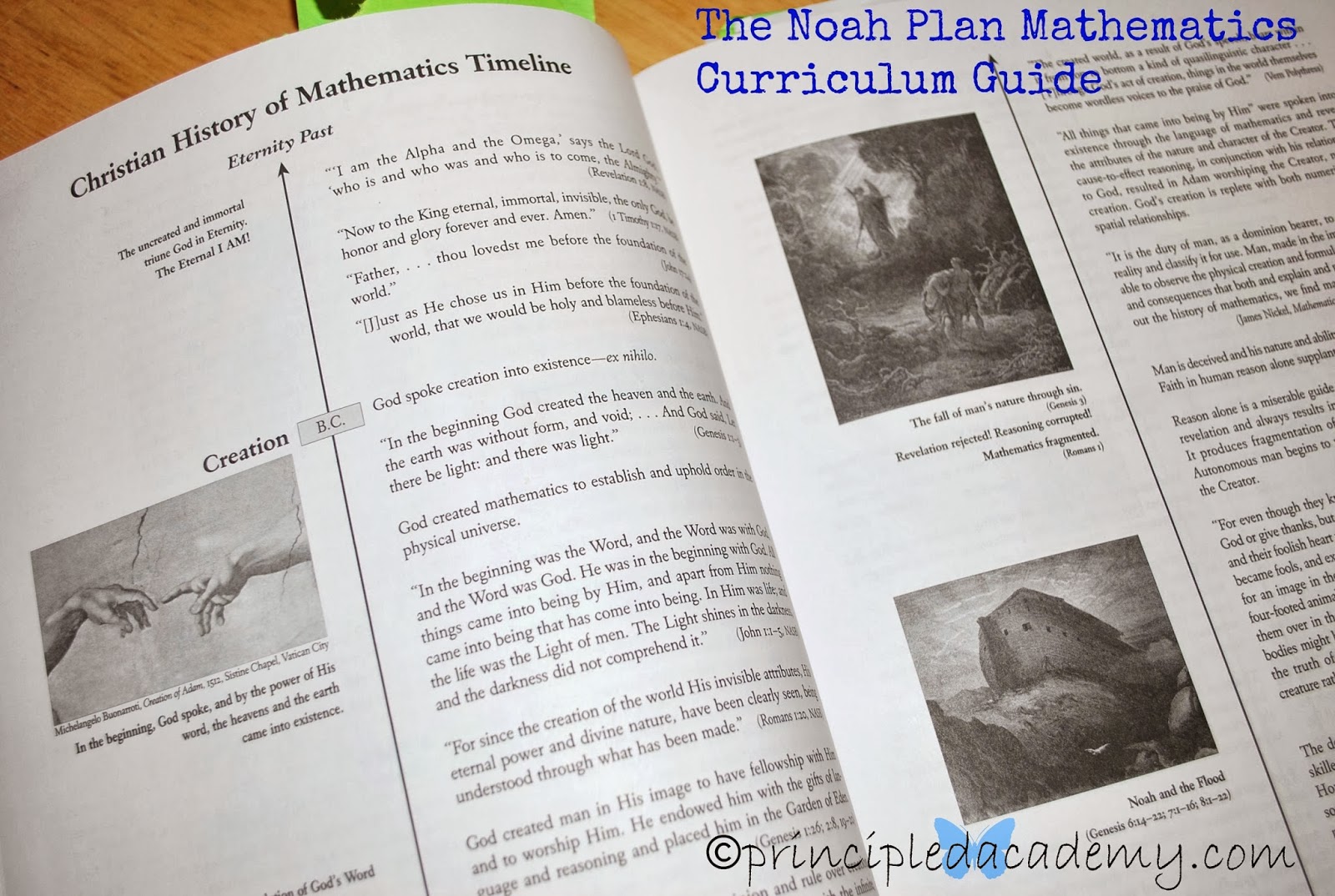
The Noah Plan Mathematics Curriculum Guide has been a huge part in opening up the artistic beauty of math in our homeschool. 

"God created the human mind with the capacity to observe, explore, formulate, explain, predict through the gift of reason, and express the results mathematically. Let us teach mathematical principles (abstractions) by using concrete pictures, analogies, and parables first, as means to the end of laying a foundation and building "line upon line" from the known to the unkown." p. 77 The Noah Plan Mathematics Curriculum Guide

Hmmmmmm..... it sounds like both hemispheres are intricately involved.

"The teacher must enable the student to know how to do mathematics (art), to know why the methods of mathematics work (science, understanding), and to know how to apply these methods to new and unfamiliar applications (wisdom). p. 78 The Noah Plan Mathematics Curriculum Guide


After-math #2. Seeing Yahweh's Providential Hand in Mathematics Adds Meaning


It's amazing to see how as mathematics unfold the ability for the Gospel to expand westward increased. Learning to see Yahweh's Providential Hand in mathematics feels relational- it allows me to know more about Him and His ability. I love sharing this with our children. 


http://legacyguardian.net/store/index.php?route=product/product&manufacturer_id=9&product_id=50


The Noah Plan Mathematics Curriculum Guide is a good starting point for someone just being introduced to all this. However, another excellent resource is Mathematics: Is God Silent? by James Nickel. 

We learn about the history timeline of mathematics (from The Beginning to the American Christian Republic/ Restoration of America). Consider it helping to move the Gospel westward...

"Christianity moves westward across the Roman roads during the missionary journeys of Paul. As a tentmaker, Paul utilized the art of computation and applied the principles of geometry to his craft."

My son, Scientist, loves astronomy and math. Because of his interest and love for these, he has opened up a whole new world to me. What a blessing! The Bible Principle of Infinity... an attribute of Yahweh, is seen mathematically in astronomy....

"Which alone spreadeth out the heavens, and treadeth upon the waves of the sea." Job 9:8 KJV 

There are many passages of Scripture which speak to this infinite stretching of the heavens. The tense for spread is active in each passage... not passive.

So, while I may struggle teaching some higher areas of mathematics, I don't have to miss out on the Scriptural truths, the poetic beauty of how it is all relevant to our Creator Yahweh. And neither do you!

After-math #3. Learning the Language of Creation.


Have you ever heard that "math is the language with which the world was spoken into existence"? 

"Mathematics is not a secular subject.... Mathematics is the language of God revealed in creation.... It is the foundation for all technical and scientific logic... Mathematics is the key to understanding the physical world and is taught in the context of science and technology." ~ pg. 7 The Noah Plan Mathematics Curriculum Guide.


{Photo courtesy of Public Domain.}


Math is in everything! Mathematical codes are in the very structures of Yahweh's creation. Have you ever pondered exactly how would Yahweh speak with numbers? Interestingly, the Hebrew language does not have a separate number system. Each letter has a number assigned to it. 


You can learn more about Fibonacci numbers at this youtube clip for Doodling in Math: Spirals, Fibonacci, and Being a Plant [1 of 3] by clicking here.


Isn't this all so fascinating? I'm excited to be a part of the after-math in teaching math. I hope you feel inspired to learn and teach Bible Principles in math, too!


Leave a comment below about your thoughts on this post. 

Monday, April 15, 2013

The Principle Approach- Line Upon Line


Have you wondered how to expand Bible Principles in your child's education? What exactly does that look like? Are you having a difficult time grasping The Principle Approach® method of teaching and learning? Then this video may be key to helping you understand!


This video shows how the Principle Approach® is a Classical Biblical education; using the "line upon line" model of education according to Isaiah 28:9, 10. 

I hope this video helps you and encourages you! Please be sure to let others know about this video presentation!


Blessings!
 

Friday, March 29, 2013

Principled Academy is on YouTube!

Happy dance! I'm hoping to help others learn more about The Noah Plan Curriculum and the Principle Approach® method by sharing presentations from time to time.

If you are unfamiliar with The Noah Plan Curriculum, I hope you watch this presentation and find it helpful! All of the resources may be purchased through my store by going here.


I'd really appreciate feedback from my readers! This presentation is about 15 minutes long and goes through the format of The Noah Plan Kindergarten Curriculum by looking at one Bible lesson and one History lesson. Won't you please take 15 minutes out of your day to watch it and leave a comment? It would be very helpful to me in serving you and other families!


How to Use the Noah Plan Curriculum


(The video can be enlarged by clicking on the "full screen" icon at the bottom of the video.)

Please help get the word out that Principled Academy is on YouTube! It just may help others learn about The Noah Plan Curriculum and Principle Approach®.


Blessings!

Tuesday, October 30, 2012

Mother Goose & King Henry the Eighth

The Noah Plan
Week 1, Quarter 2

What do you know about the history of Mother Goose? Quarter two of The Noah Plan K Curriculum has us learning about her... and the timing couldn't be more perfect! 

For instance, are you aware that the Mother Goose nursery rhymes were written during the rule of King Henry the Eighth? Yes! It was exactly around the time that the Reformation was taking place. It was also exactly around the time of the Separatists... who would later have the courage to become Pilgrims for the sake of the Gospel! This goes along perfectly with our Reformation studies which are still taking place in our home.

This image was found in the Public Domain here.
*I altered it with a border.

I'll share a little about one of the Mother Goose rhymes which I learned about from The Noah Plan Literature Curriculum Guide:

"Little Jack Horner" eating his "Christmas pie" and pulling out a "plum" illustrates the wicked policies of Henry the Eighth. The pie, which a real Mr. Horner was supposed to be carrying to the king, contained twelve little deeds to certain church estates which Henry the Eighth was repossessing from the church now separated from Rome. Jack's plum was one of these deeds which he claimed to have been given him from the king. The descendants of Jack Horner do indeed possess the original deed bearing the king's signature though they deny it was ever a plum in a pie but rather came to them direct from the king."
-p. 95 The Noah Plan Literature Curriculum Guide
Isn't that so interesting?! How many of us have just simply read through the rhymes simply enjoying them and having no knowledge of what is behind them? 

Since I have added studies about the Reformation to our homeschool, I am only covering a couple of the nursery rhymes in the Noah Plan lesson for this week. 


Blessings!
P.S.
Have you expanded your studies on Mother Goose and/or her nursery rhymes? If so, please share with us what you have learned!

Sunday, October 28, 2012

Days of Creation!

The Noah Plan 
Bible- Week 1, Quarter 2
 

{Get your free notebook page at the end of this post}

We're in Quarter Two already! How is it going for your family so far? It'd be wonderful if you'd leave a comment about what you are loving about The Noah Plan curriculum... or even the Principle Approach®  in general! I'd love to know!

Likely this has been something your children have learned in Sunday School, but please do not skip over it! I still taught this to our children because... they are our children and I want them to learn that the Bible is not redundant! There are always things to learn from passages we have read over regardless the number of times.

© Principled Academy
The Creation of Adam -Michelangelo
 
This Noah Plan Curriculum lesson goes over why God created all the different things He did. The kids also go over the different categories. We go into a deep discussion about how God created man in His image- distinct from from ALL animals and plants!


If you want to have a notebook page for your child's notebook then you can print one out. And/or you can have them do art projects and use notebook sheets in relation to those art lessons. I'd like to encourage you to read these posts because they cover questions like...


Blessings!